Respiratory physiology: pneumocytes
On this page
There are two main types of pneumocytes:
Pulmonary surfactant
Pulmonary surfactant is a mixture of phospholipids and proteins that reduces surface tension within alveoli. Surfactant performs the following basic functions via its effect on surface tension:
Surfactant contains hydrophillic heads which absorb onto the wet surface of the alveolar sac whilst hydrophobic tails face the air filled centre of the alveolar sac.
When alveoli increase in size during inspiration, surfactant becomes more spread out (less concentrated) and surface tension increases effectively slowing the rate of expansion of the alveoli. When alveoli decrease in size during expiration the concentration of surfactant increases reducing surface tension. This helps alveoli expand and contract in a uniform manner as one that expands more quickly will experience a large rise in surface tension slowing its rate of expansion whilst an alveoli which reduces in size more quickly will have surface tension reduce more, so other alveoli can contract more easily than it can.
| Cell type | Roles & information |
|---|---|
| Type 1 pneumocytes | Facilitate gas exchangeVery thin squamous cells which cover around 97% of the alveolar surface |
| Type 2 pneumocytes | Secrete surfactantCuboidal cells Start to develop around 24 weeks gestation, however adequate surfactant production does not take place until around 35 weeks so premature babies are prone to respiratory distress syndrome Can differentiate into Type 1 pneumocytes during lung damage |
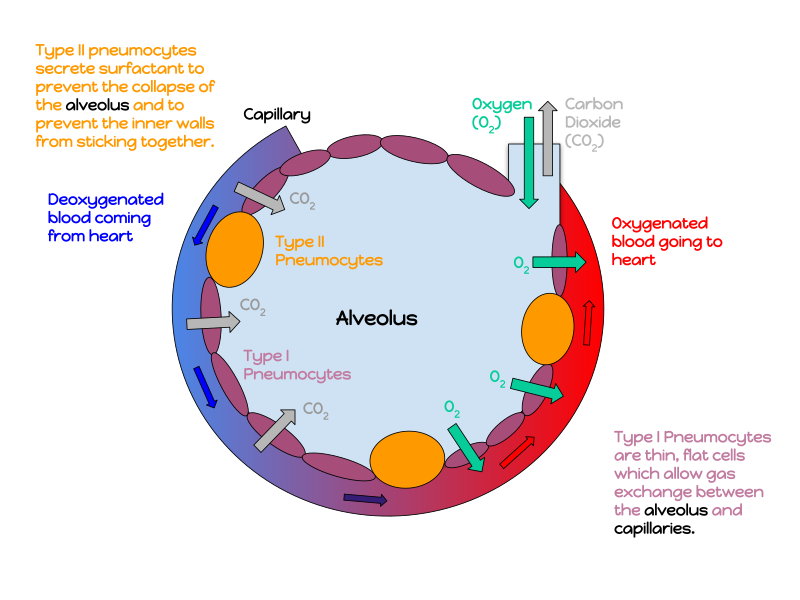 | |
Illustration of alveolus. Click on image to enlarge
Pulmonary surfactant
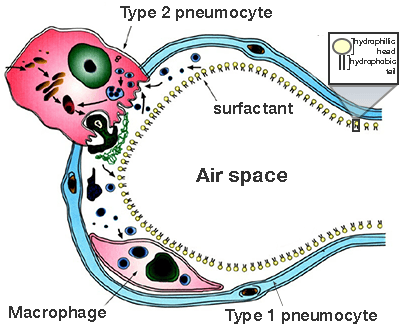
Pulmonary surfactant is a mixture of phospholipids and proteins that reduces surface tension within alveoli. Surfactant performs the following basic functions via its effect on surface tension:
- Increases pulmonary compliance
- Prevent atelectasis at the end of expiration
- Recruitment of collapsed airways
Surfactant contains hydrophillic heads which absorb onto the wet surface of the alveolar sac whilst hydrophobic tails face the air filled centre of the alveolar sac.
 | |
When alveoli increase in size during inspiration, surfactant becomes more spread out (less concentrated) and surface tension increases effectively slowing the rate of expansion of the alveoli. When alveoli decrease in size during expiration the concentration of surfactant increases reducing surface tension. This helps alveoli expand and contract in a uniform manner as one that expands more quickly will experience a large rise in surface tension slowing its rate of expansion whilst an alveoli which reduces in size more quickly will have surface tension reduce more, so other alveoli can contract more easily than it can.
Law of Laplace
Alveoli are wet and surround an air space. Surface tension acts at the air-water interface to collapse air pockets within water. The gas pressure (P) needed to keep equilibrium between the collapsing force of surface tension (γ) and the expanding force of gas in an alveolus of radius r is described by the law of Laplace: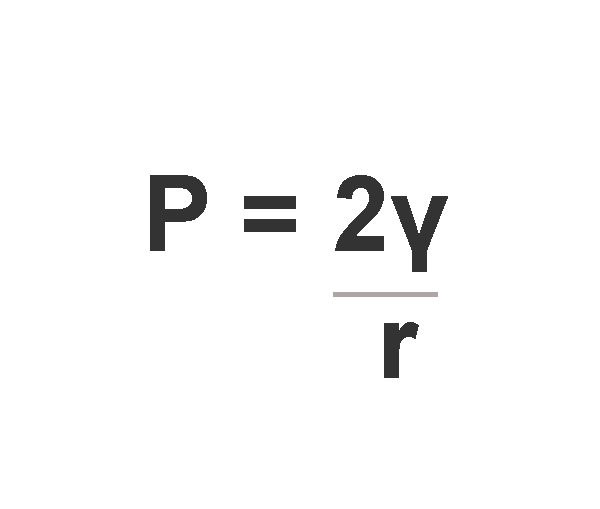 | |