Nasal cavity
On this page
Overview of the nasal cavity
The nasal cavity refers to the air filled space above and behind the nares. Some refer to the nasal cavities as two i.e. divided by the nasal septum whilst others consider the nasal cavity as one space encompassing both sides.
The nasal cavity has a number of important functions:
- Warms and humidifies air
- Traps pathogens and particles
- Passage for drainage of lacrimal secretions and paranasal sinuses
- Smell
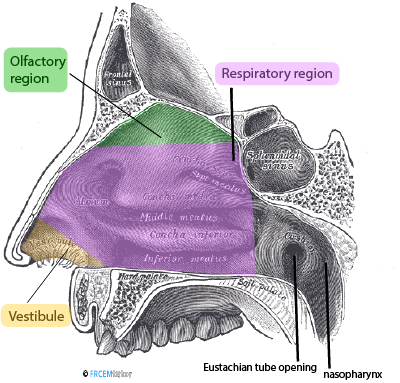
The nasal cavity extends from the vestibule anteriorly to the nasopharynx posteriorly. It can be divided into three parts:
- Vestibule
- Respiratory region
- Olfactory region
 | |
| Boundary | Details |
|---|---|
| Floor |
|
| Roof |
|
| Medial wall |
|
| Lateral wall |
|
The lateral walls
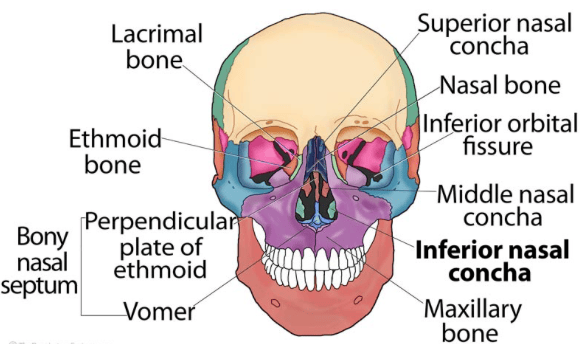
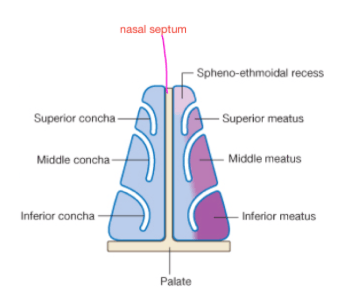
- Each lateral wall contains 3 projections called conchae or turbinates
- Below each conchae there is a corresponding meatus
- The meatuses have openings for the paranasal sinuses
- The paranasal sinuses are connected to the nasal cavity through small orifices called ostia.
The following images show the cross sectional anatomy of the conchae relative to the skull and the second image shows a schematic representation
 | |
 | |
Clinical significance
The inflammation and hypertrophy of the mucus membrane overlying the inferior concha is characteristic of rhinitis and gives rise to nasal obstruction.
Blood supply of the lateral walls
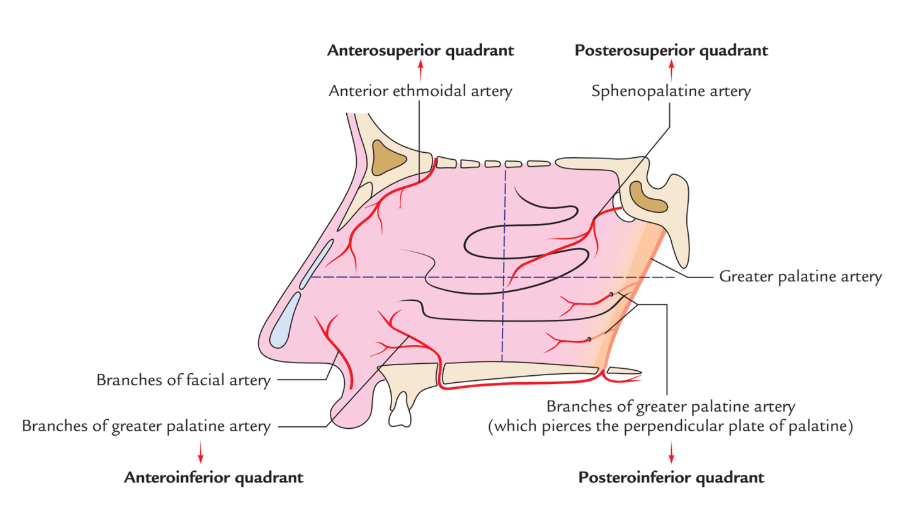
The arterial blood supply to the lateral walls can be neatly divided into quadrants as below:- Anterosuperior quadrant: anterior ethmoidal artery
- Anteroinferior quadrant: greater palatine and and branches of facial artery
- Posterosuperior quadrant: sphenopalatine artery
- Posteroinferior quadrant: greater palatine artery
 | |
Blood supply of the nasal septum and Little's area
Little's area is an area of the anteroinferior nasal septum where four arteries take part in an anastomosis. It is the most common source of epistaxis. The four arteries (source in brackets) are:
- Anterior ethmoidal artery (ophthalmic artery)
- Greater palatine artery (maxillary artery)
- Sphenopalatine artery (maxillary artery)
- Superior labial artery (facial artery)
As Little's area is part of the nasal septum it is right to assume that all of the arteries above provide arterial supply to the septum. In addition to the arteries listed above the posterior part of the nasal septum also receives supply from the:
- posterior ethmoidal artery (ophthalmic artery)
 | |
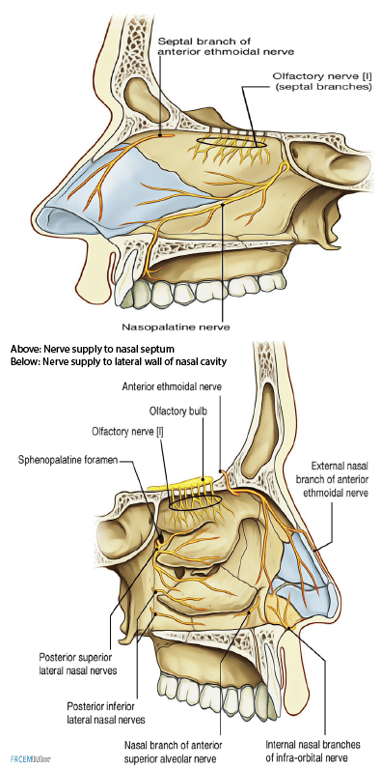
Nerve supply
The nerve supply to the nasal cavity consists of specialised olfactory nerve cells provided by the olfactory nerve and sensory nerves derived from the ophthalmic and maxillary divisions of the trigeminal nerve (V1 and V2)
The anterior ethmoidal nerve is the main sensory nerve supplying the anterior nasal cavity and is a branch of the nasociliary nerve which in turn arises from the ophthalmic division of the trigeminal nerve (V1). The posterior nasal cavity meanwhile is primarily supplied via nerves arising from the maxillary division of the trigeminal nerve (V2) via the pterygopalatine ganglion.
The nerve supply is further detailed below:
Nerve supply to nasal septum
The nasal septum is supplied by the following- Olfactory nerve (specialised olfactory nerve ends)
- Anterior ethmoidal nerve (Internal nasal branch)
- Nasopalatine nerve (branch of the pterygopalatine ganglion / maxillary nerve V2)
- Greater palatine nerve (branch of the pterygopalatine ganglion / maxillary nerve V2)
Nerve supply to lateral walls
The lateral walls of the nasal cavity can be thought of as being supplied by quadrant, much like the arterial supply, and are supplied by
- anterosuperior quadrant: anterior ethmoidal nerve
- anteroinferior quadrant: infraorbital nerve
- posteroinferior quadrant: greater palatine nerve (branch of the pterygopalatine ganglion) via posterior inferior lateral nasal branches
- posterosuperior quadrant: posterior superior lateral nasal branches of the pterygopalatine ganglion
- Olfactory nerve (specialised olfactory nerve ends)
 | |