Acromioclavicular joint: anatomy and dislocation
Key Points
- Joint allows pectoral movement
- Synovial joint
- Dislocation is a common injury presenting to A&E departments
- Typically from fall onto shoulder or direct blow
- Severity classified using Rockwood system and graded from 1-6
- Grades I-III usually treated conservatively
 | |
| Wikipedia | |
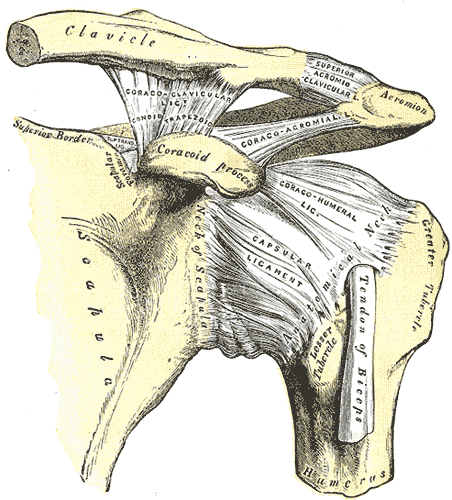
Illustration of intact shoulder ligaments
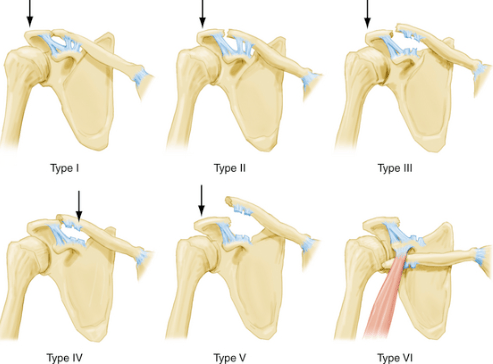 | |
Rockwood classification of AC dislocation
| Grade | AC ligament | CC ligament | Joint capsule | deltoid and trapezius muscles | Specific features |
|---|---|---|---|---|---|
| 1 | Sprain | In tact | In tact | In tact | clavicle not elevated relative to acromion |
| 2 | Ruptured | Sprain | Ruptured | in tact | clavicle elevated but not above the superior border of the acromion |
| 3 | Ruptured | Ruptured | Ruptured | detached | clavicle elevated above the superior border of the acromion but coracoclavicular distance is less than twice normal (i.e. <25 mm) |
| 4 | Ruptured | Ruptured | Ruptured | detached | clavicle displaced posteriorly into trapezius |
| 5 | Ruptured | Ruptured | Ruptured | detached | clavicle is markedly elevated and coracoclavicular distance is more than double normal (i.e. >25 mm) |
| 6 | Ruptured | Ruptured | Ruptured | detached | clavicle inferiorly displaced behind coracobrachialis and biceps tendons |
Video illustrating severity of AC dislocation