Peritoneum
On this page
Basic principles
The peritoneum is composed of visceral and parietal layers with serous fluid in a small cavity between the two layers that allows the layers to glide over one another.
Parietal peritoneum lines the walls of the abdomen and pelvis whereas visceral peritoneum covers the organs.
Parietal peritoneum
- Diaphragmatic section innervated by phrenic nerves and T7-T12 spinal nerves
- Abdominal section innervated by T7-L1
- Pelvic section innervated by obturator nerve.
- Sensitive to pain, temperature, touch and pressure
Visceral peritoneum
- Sensitive only to stretch and tearing
- Supplied by autonomic nerves relative to organ.
Peritoneal compartments
The peritoneum is divided into supracolic and infracolic compartments by the transverse mesocolon. The infracolic compartment is further subdivided into left and right infracolic spaces by the root of the small bowel mesentery. The anatomy is illustrated in the image below:
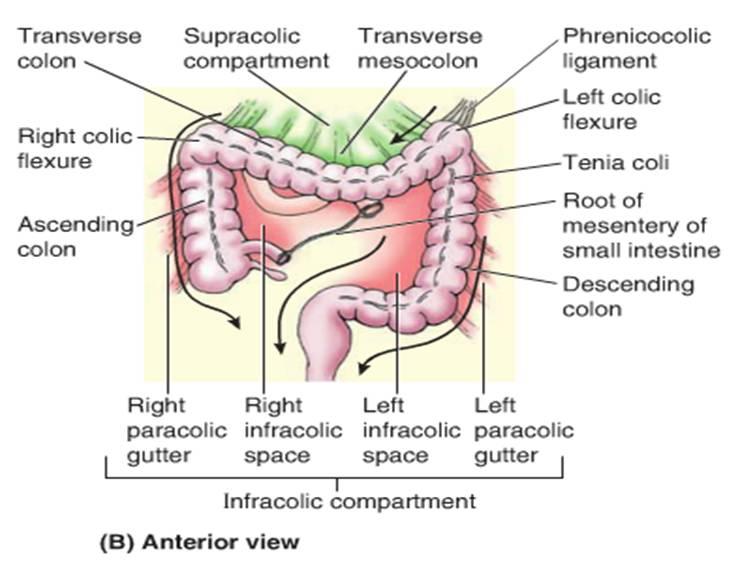 | |
Diagram illustrating supracolic and infracolic compartments divided by transverse mesocolon
Mesenteries
A mesentery is a peritoneal fold that attaches the viscera to the posterior abdominal wall. There are three main mesenteries:
- Transverse mesocolon (mesentery of transverse colon)
- Sigmoid mesocolon (mesentery of sigmoid colon)
- Mesentery of small intestine
The root of the mesentery of the small intestine is a broad fan like structure that is connected to the posterior abdominal wall. It is approximately 15cm long and originates at the duodenojejunal flexure to the left of L2 and extends obliquely to the right lower quadrant anterior to the upper part of the right SIJ.
The sigmoid mesocolon is an inverted 'V' shaped mesentery. The apex overlies the bifurcation of the left common iliac artery and left ureter. The medial limb (lower or right limb) ends inferiorly anterior to the S3 vertebra. The lateral limb (upper or left limb) ends inferiorly at the medial edge of the left psoas muscle.
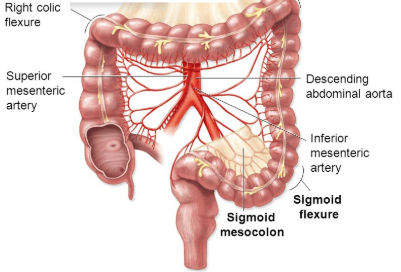 | |
The inverted V shaped sigmoid mesocolon is highlighted. The transverse mesocolon can also be seen superiorly