Cardiovascular Physiology: Microcirculation & transcapillary exchange
The microcirculation is a vital component of the cardiovascular system as it is within the microcirculation that exchange between blood and tissues occurs. The microcirculation consists of the smallest arterioles, capillaries and venules. It is within the capillaries and venules that exchange occurs.
Flow through the microcirculation is primarily regulated by vasoconstriction of arterioles. Vasoconstriction of small arterioles is activated by sympathetic stimulation of nerve endings within the their arteriole walls whereas the smallest terminal arterioles (called metarterioles) lack nerve endings and vasoconstriction here is regulated by local metabolic products.
The flow within the microcirculation is typically from arterioles to capillaries to venules, as shown below, however some tissues such as the mesentery have direct connections.
Lipophilic molecules (soluble in lipids) such as oxygen and CO2 are able to pass through the phospholipid bilayer of the capillary wall easily along their diffusion gradient.
The phospholipid membrane is impermeable to hydrophilic molecules (soluble in water, insoluble in lipids) such as glucose and charged molecules and ions. These substances must pass through gaps between cells. Tight junctions between cells and glycocalyx (a protein layer) slows diffusion of these molecules even further.
These gaps act like small pores but given their small size they will not allow substances larger than 10,000 Da (e.g. plasma proteins) to cross the capillary membrane. Larger molecules may pass through large pores or fenestrations in the capillaries if present. Capillaries vary in their structure and membrane permeability depending on their location in the body as summarised below:
Flow through the microcirculation is primarily regulated by vasoconstriction of arterioles. Vasoconstriction of small arterioles is activated by sympathetic stimulation of nerve endings within the their arteriole walls whereas the smallest terminal arterioles (called metarterioles) lack nerve endings and vasoconstriction here is regulated by local metabolic products.
The flow within the microcirculation is typically from arterioles to capillaries to venules, as shown below, however some tissues such as the mesentery have direct connections.
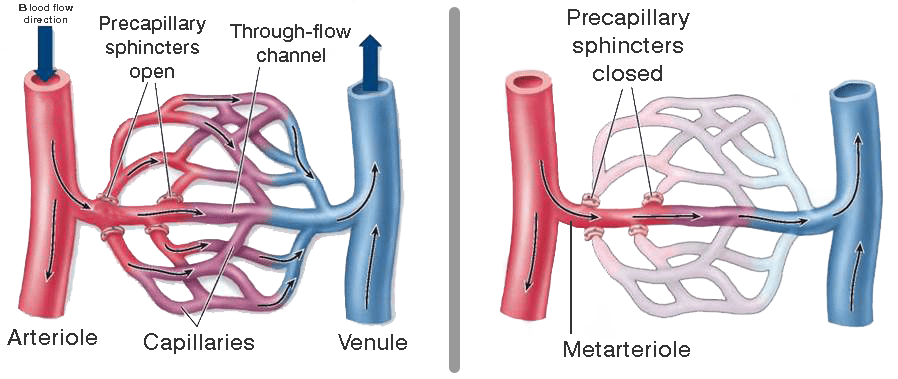 | |
Left side shows capillary sphincters open and blood flowing through capillary network. Right side shows capillary sphincters closed interrupting flow to capillary network and limited flow from metarteriole (terminal arteriole) to post-capillary venule via through channel click on image to enlarge
Transcapillary exchange
Exchange of substances in the microcirculation is reliant on those substances being able to cross the capillary wall.Lipophilic molecules (soluble in lipids) such as oxygen and CO2 are able to pass through the phospholipid bilayer of the capillary wall easily along their diffusion gradient.
The phospholipid membrane is impermeable to hydrophilic molecules (soluble in water, insoluble in lipids) such as glucose and charged molecules and ions. These substances must pass through gaps between cells. Tight junctions between cells and glycocalyx (a protein layer) slows diffusion of these molecules even further.
These gaps act like small pores but given their small size they will not allow substances larger than 10,000 Da (e.g. plasma proteins) to cross the capillary membrane. Larger molecules may pass through large pores or fenestrations in the capillaries if present. Capillaries vary in their structure and membrane permeability depending on their location in the body as summarised below:
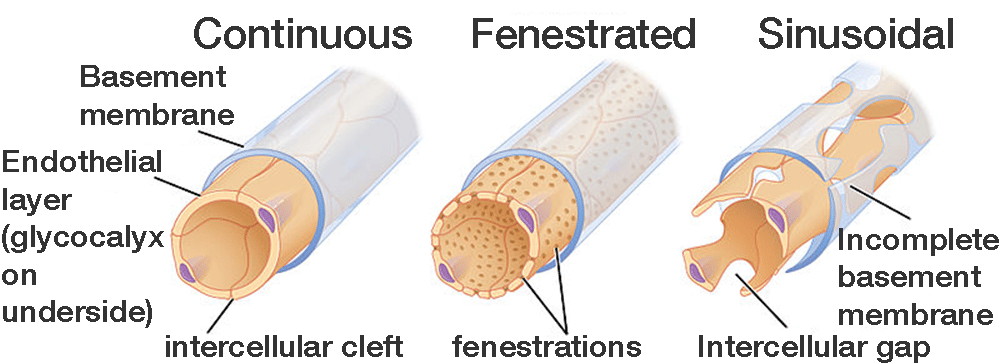 | |
Continuous capillaries are the least permeable type of capillary. They are found in skin, fat, muscle and nervous tissue (including the blood brain barrier).
Fenestrated capillaries are more permeable than continuous capillaries and are found in the gastrointestinal tract, joints and kidneys.
Sinusoidal or discontinuous capillaries are the most permeable type and occur where red cells need to cross the capillary wall such as the bone marrow, spleen and liver