Respiratory physiology: alveolar diffusion
On this page
Transfer factor
Transfer factor is also known as diffusing capacity. It is a measure of how efficiently the lung is able to exchange gases between air and the alveolar capillaries. When measuring transfer factor the test may be referred to by one of the following two terms:- DLCO: Diffusing capacity of the Lung for carbon monoxide (CO)
- TLCO: Transfer factor of the Lung for carbon monoxide (CO)
Transfer factor testing typically involves measuring carbon monoxide levels rather than oxygen. This is because CO has a high affinity for haemoglobin (200-250 times that of oxygen) and does not readily dissociate from haemoglobin as oxygen does. This gives a more accurate reflection of gas exchange between inspired air and the pulmonary capillaries.
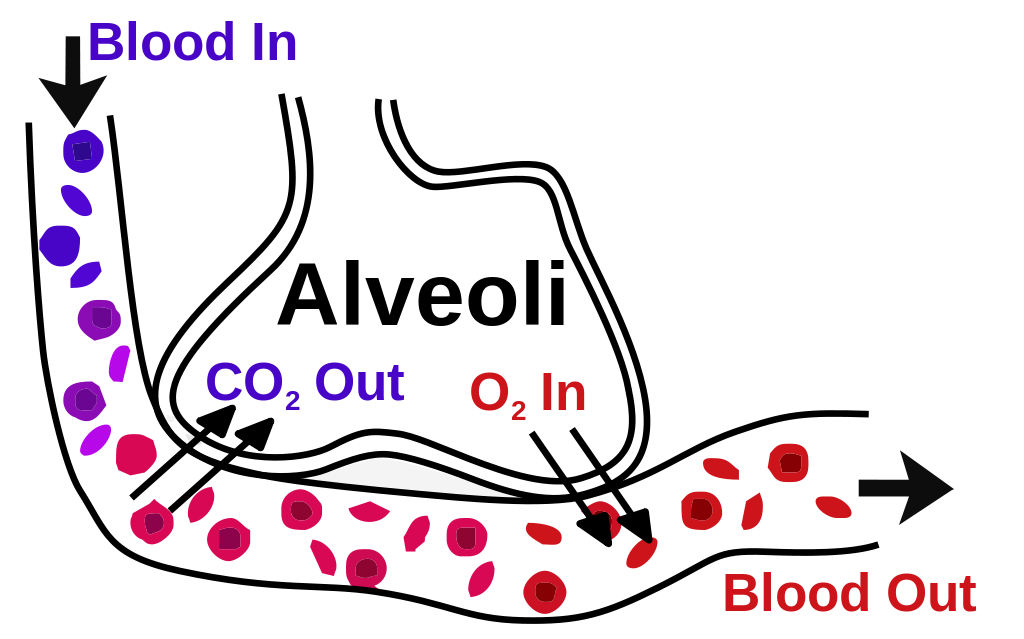 | |
Diffusion across the alveolar-capillary membrane
Conditions that reduce the alveolar-capillary membrane area or increase the membrane thickness will reduce the capacity to transfer gas. Reduced blood volume will also reduce the transfer factor. Conditions that increase blood volume will have the opposite effect and increase the transfer factor. These are summarised in the table below
| Factors decreasing TLCO | Factors increasing TLCO |
|---|---|
Increased alveolar wall thickness:
Cardiac insufficiency Pulmonary hypertension Drugs:
Anaemia | Polycythaemia Asthma (may be normal) Increased pulmonary blood flow e.g. exercise Left to right intra-cardiac shunting Mild left heart failure (increased blood volume) |
Diffusion & Perfusion Limitation
Carbon monoxide (CO) has a high affinity for haemoglobin and binds avidly to it. The rate of transfer of CO from the air to the capillary blood is therefore not affected by blood flow (perfusion) as there is always adequate haemoglobin. Transfer of CO is solely limited by the rate of transfer across the capillary membrane, as such carbon monoxide is said to be diffusion limited.For oxygen and other poorly soluble gases the partial pressure in the alveolar air and the blood can quickly reach equilibrium preventing further diffusion along the diffusion gradient i.e. from high to low partial pressure. Increasing blood flow restores the gradient and allows further diffusion to occur. For this reason oxygen transfer is said to be perfusion limited.
- Carbon monoxide transfer is said to be diffusion limited
- Oxygen transfer is said to be perfusion limited