Fluid space composition
Intracellular & extracellular fluids
Concentrations of ions in fluid compartments are usually controlled within narrow physiological limits via homeostatic mechanisms. Within each compartment electrical neutrality is maintained. Differences in ion concentrations between the compartments allow for the generation of concentration gradients and ionic movement is typically controlled via ion channels.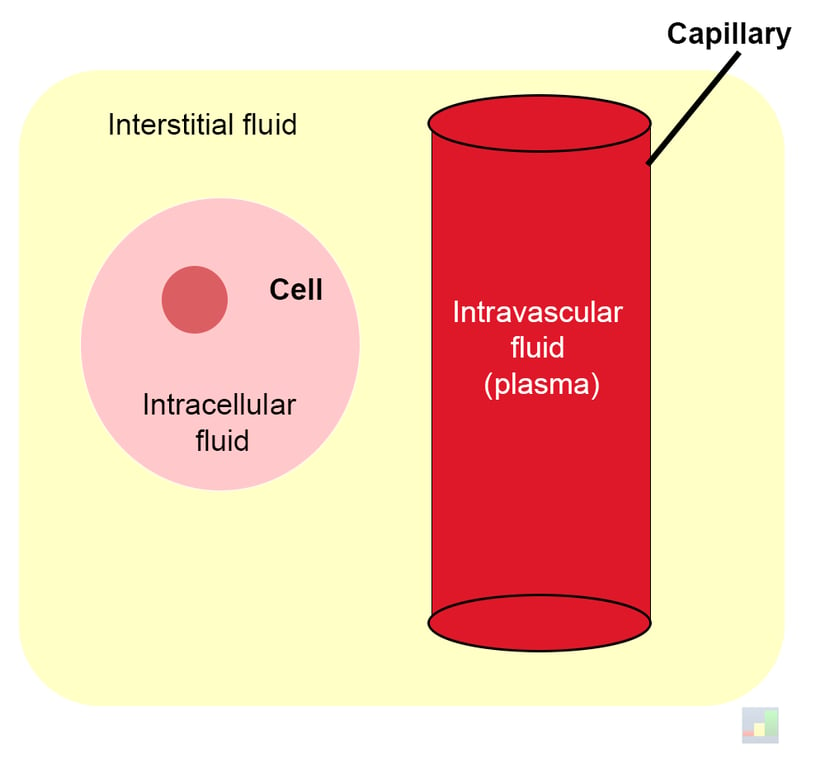 | |
Basic illustration of fluid compartments. Click on image to enlarge
As can be seen by the table below there are significant differences in the ion concentration between intracellular fluid and extracellular fluid (remember ECF comprises plasma and interstitial fluid)
| Ion | Intracellular concentration | Extracellular concentration |
|---|---|---|
| Na+ | 10 mmol/L | 140 mmol/L |
| K+ | 140 mmol/L | 4 mmol/L |
| Ca2+ | 0.0001 mmol/L | 1 mmol/L |
| Cl- | 3-30 mmol/L | 108 mmol/L plasma 129 mmol/L interstitial |
| HCO3- | 9 mmol/L | 26 mmol/L |
| PO43- | 60-88 | 3 mmol/l |
| SO43- | 60-88 | 3 mmol/l |
| Proteins- | 50 mmol/l | 1-10 mmol/l |
There is constant movement or leak of Na+ and K+ along their concentration gradients which drives towards equalising the ion concentrations in the ECF and ICF. This would be catastrophic for cell signalling (in fact it would be fatal as the severe hyperkalaemia would stop cardiac function long before the ECF and ICF potassium concentrations got close to being equalised) and is prevented by the Naº/Kº-ATPase pump
Calcium ions (Ca2+) are actively transported out of the cell or into the endoplasmic reticulum and mitochondria of the cell resulting in very low levels of free calcium ions in the cell cytosol.
The main anion (negatively charged ion) content of intracellular fluid is composed of intracellular proteins which are anionic, chloride ions (Cl-) which are distributed across the plasma membrane of cells and some other large anions such as phosphate.
Intracellular anionic proteins and large anions such as phosphate are too large to cross the cell membrane leaving them trapped inside the cell. As same charged ions repel one another these trapped ions force smaller anions, such as Cl-, that can diffuse across the plasma membrane out of cells. The repellent electrical force driving Cl- out of cells is balanced by the concentration gradient driving Cl- back into the cell. This phenomena is known as the Gibbs-Donnan equilibrium.
The Donnan equilibrium
The Donnan equilibrium, also known as the Gibbs-Donnan equilibrium, Gibbs-Donnan effect and Donnan law refers to how charged particles fail to distribute evenly across two sides of a semi permeable membrane. This is usually caused by the presence of different charged particles that cannot pass freely through the semi-permeable membrane.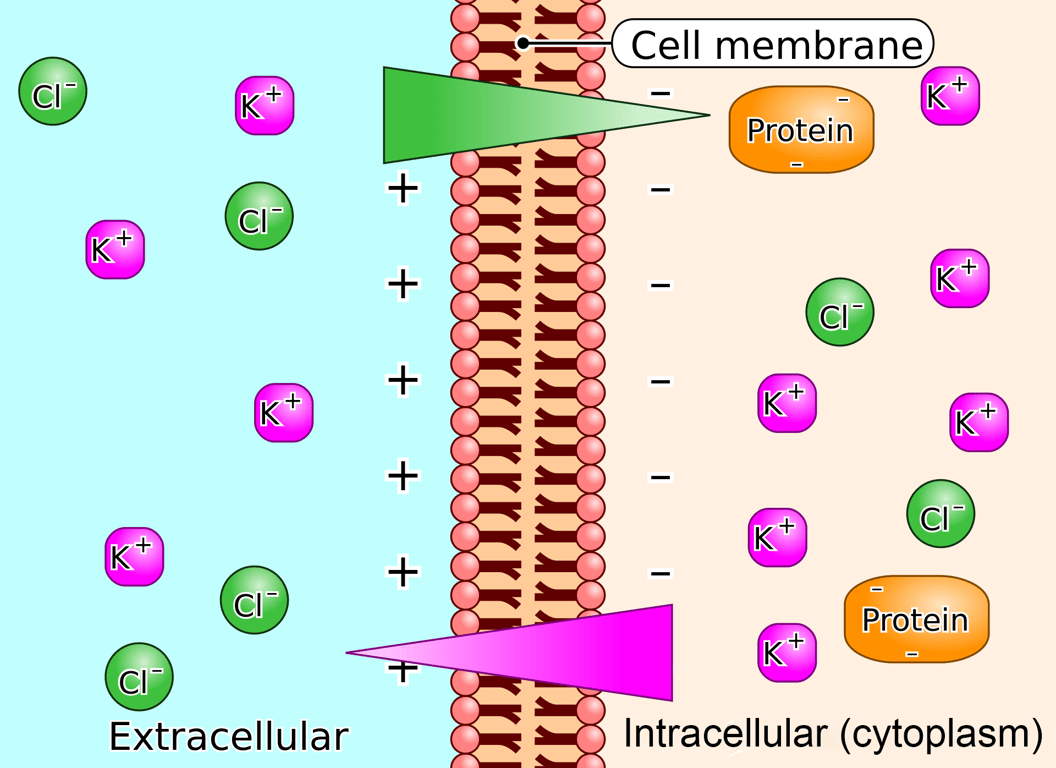 | |
Gibbs-Donnan equilibrium. Click on image to enlarge
Extracellular fluids
Extracellular fluid (ECF) is comprised of interstitial fluid and plasma. The main difference between these fluids is that plasma has a much higher concentration of proteins which are unable to cross the capillary wall in normal circumstances. These proteins are anions and the main protein is albumin.
Albumin is the main protein contributing to oncotic pressure
These proteins exert an osmotic force termed plasma oncotic pressure. Albumin accounts for around 80% of the total oncotic pressure exerted by blood plasma on interstitial fluid. Oncotic pressure acts to draw water into the plasma and is an antagonistic force to hydrostatic pressure which forces water out of capillaries. The overall net effect of these two forces is a small volume of water movement out of capillaries. This fluid is typically absorbed by the lymphatic system.
Transcellular fluids
Some consider these fluids a component of ECF whilst others consider these fluids to lie outside of the main fluid compartments. Transcellular fluids are contained within epithelial lined spaces. They total around 2L in an average adult and consist of:- CSF
- Exocrine secretions
- Aqueous humor in the eye
- Serous fluid in the serous membranes lining body cavities
- Perilymph and endolymph in the inner ear
- Synovial fluid