Vessel fluid dynamics: flow through a tube
Flow
Flow or volumetric flow rate describes the volume of fluid moving per unit time and is typically measured in m3/s.
Flow through a tube is dependent on the pressure difference between the two ends of the tube (P1 - P2) and the resistance provided by the tube. This is Darcey's law and is shown by the equation below:
Darcey's law
Flow = P1 - P2 /R
OR
Flow = ∆P/R
Resistance is the result of friction and is determined by the diameter of the tube and the viscosity of fluid. This is Poiseuille's law and is shown be the equation below:
Poiseuille's law
R = (8VL)/ πr4R= resistance, V= viscosity of liquid, L = length of tube, r = radius of tube
These equations show that flow is proportional to the radius4 (or diameter4 ). Small changes in radius can therefore have a significant effect on flow rate.
These equations may be combined as:
Flow = ∆Pπr4/(8VL)
Increasing viscosity slows flow and conditions that increase viscosity such as polycythaemia reduce flow rates.
Key points
- Flow is directly proportional to the pressure difference between two ends of a tube
- Flow is directly proportional to radius 4
- Flow is inversely proportional to tube length
- Flow is inversely proportional to viscosity
Laminar & turbulent flow
Frictional forces at the sides of a tube produces drag. The result is flow is greatest at the centre of a tube. This is termed Laminar flow and is the model which applies to flow in the normal cardiovascular system. A consequence of this is blood cells tend to move away from vessel walls and accumulate in the centre of the vessel - a phenomena known as axial streaming. Blood cells also tend to align themselves to the direction of flow. In small vessels this reduces viscosity and minimises resistance, known as the
FÃhraeus-Lindqvist effect
With high flow velocity laminar flow may be disrupted and flow may become turbulent. Turbulence is multi-directional and increases resistance. Turbulence of fluid flow is heard as murmurs whilst turbulence of air flow is heard as wheeze.
Narrowing of tubes increases the velocity of flow (note flow rate will typically decrease despite the increasing flow velocity as flow volume drops) and the likelihood of turbulence developing, especially in large arteries or points where velocity increases sharply e.g. across valves. This is important as turbulent blood flow increases the risk of thrombus formation.
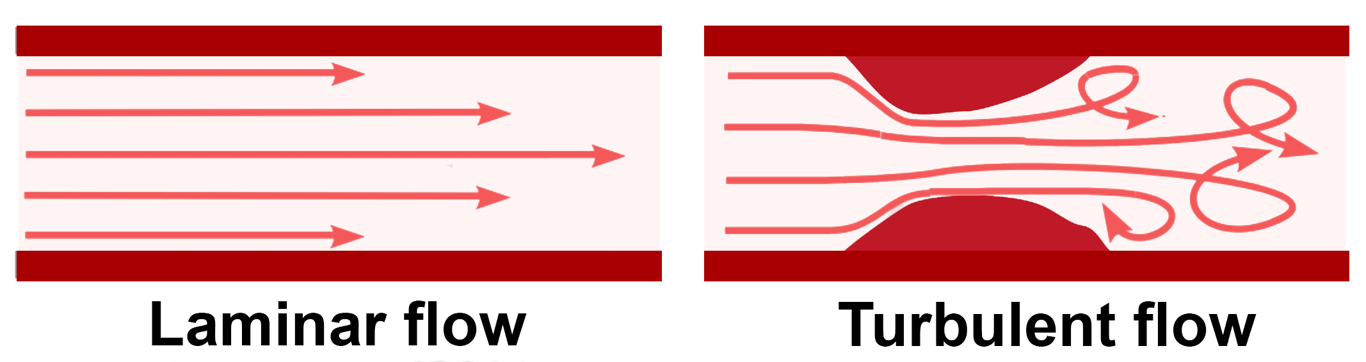 | |
Laminar flow and turbulent flow. click on image to enlarge
The Korotkoff sounds are an example of turbulent flow. The pressure from the cuff constricts the artery causing velocity to increase and turbulent flow to develop which is audible. When the pressure completely stops flow the turbulence stops.
Resistance
The vascular system contains vessels which may lie in series or parallel. Flow through a series of tubes is restricted by the resistance of each tube and the resistance is the sum of the resistance of each tube i.e.RT = R1 + R2 + R3 + ...
Tubes in parallel reduce resistance is reduced as below: RT = 1/ (1/ R1 + 1/R2 + 1/R3 + ...)
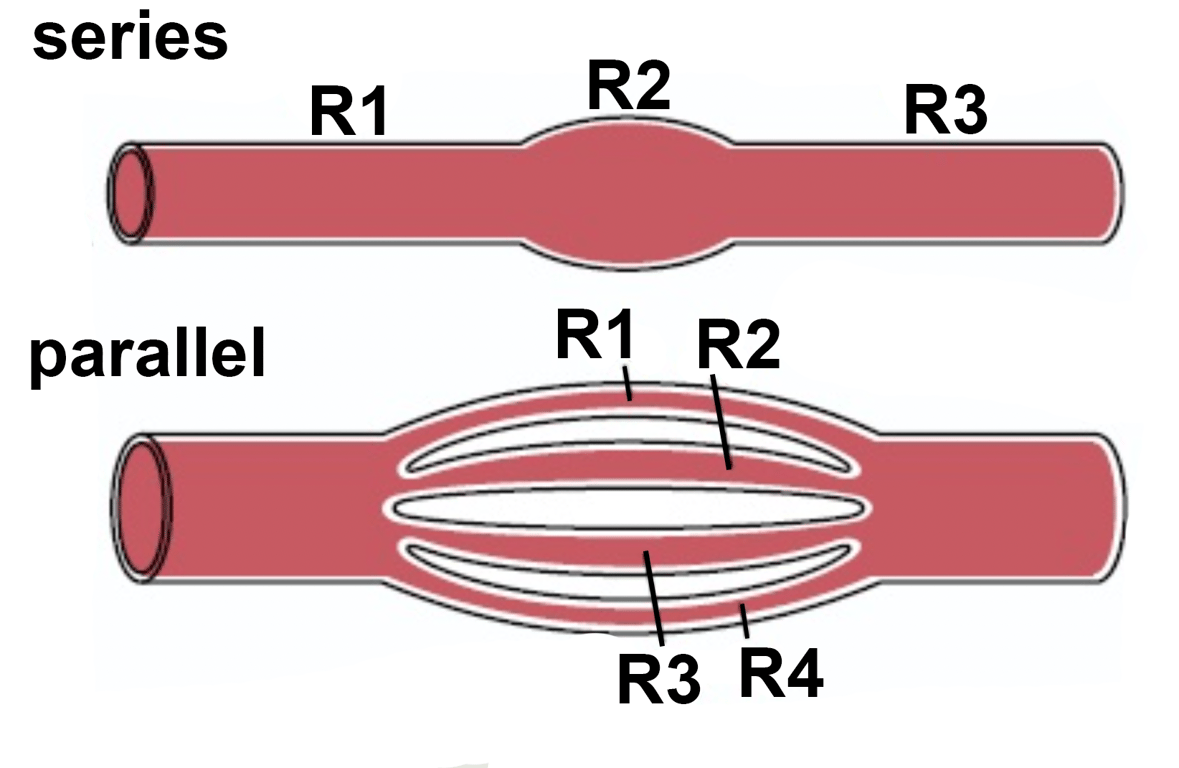 | |
Resistance in series and parallel. click on image to enlarge