Aldosterone
Aldosterone is synthesised and secreted by the zona glomerulosa of the adrenal cortex. Aldosterone is classed as a mineralocorticoid & is the primary mineralocorticoid of the human body. Aldosterone functions to regulate salt and water homeostasis.
Factors that stimulate aldosterone production
Mechanism of action
Aldosterone acts mainly at the renal distal convoluted tubule (DCT) and collecting ducts to cause sodium retention and potassium loss. Aldosterone acts via protein synthesis so its effects take hours to work
Aldosterone's main effects are though its actions on two cell types:
Firstly on the principle cells of the renal tubules aldosterone increases expression of:
Aldosterone acts on alpha intercalated cells of the collecting duct to increase expression of the following:
Factors that stimulate aldosterone production
- Angiotensin II
- High potassium (K+)
- Fluid loss as detected by atrial stretch receptors
- ACTH (minor stimulant)
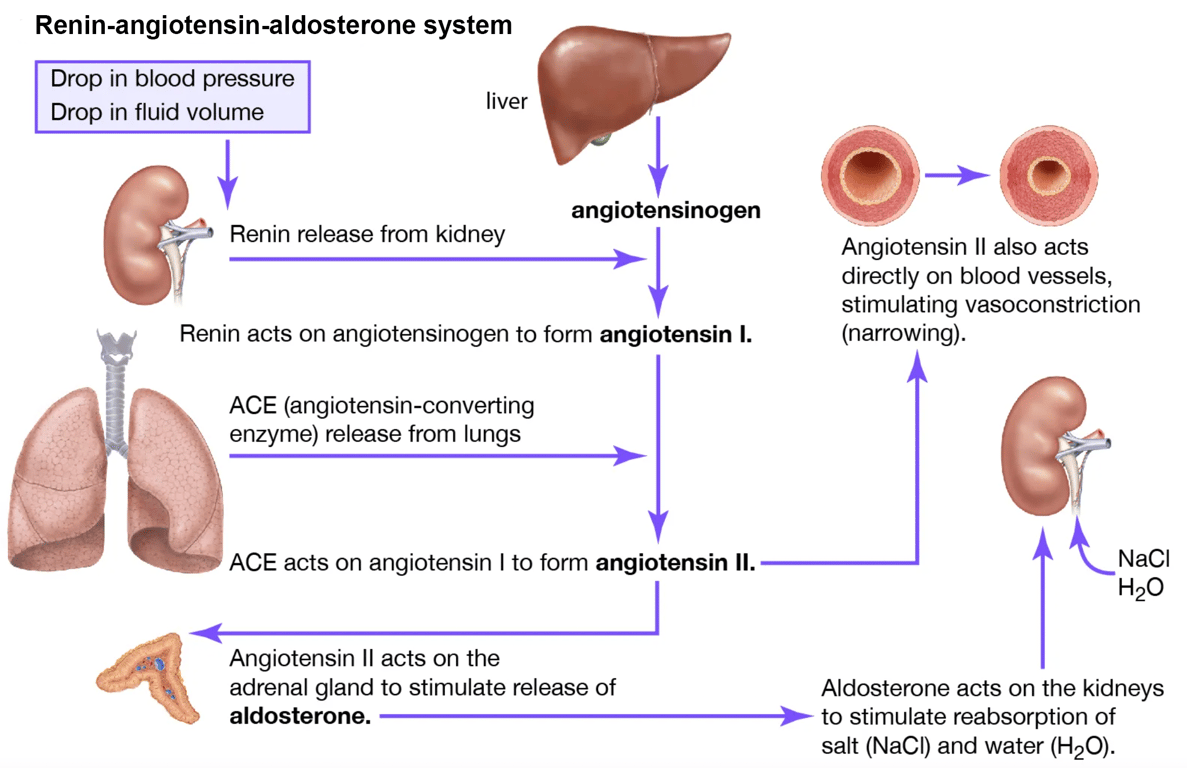 | |
Click on image to enlarge
Mechanism of action
Aldosterone acts mainly at the renal distal convoluted tubule (DCT) and collecting ducts to cause sodium retention and potassium loss. Aldosterone acts via protein synthesis so its effects take hours to work
Aldosterone's main effects are though its actions on two cell types:
- Principle cells of the distal tubule
- Intercalated cells of the collecting duct
Firstly on the principle cells of the renal tubules aldosterone increases expression of:
- Na+/K+ pump (Na+/K+ ATPase pump) on the basolateral membrane
- ENaC sodium ion channels on the apical membrane
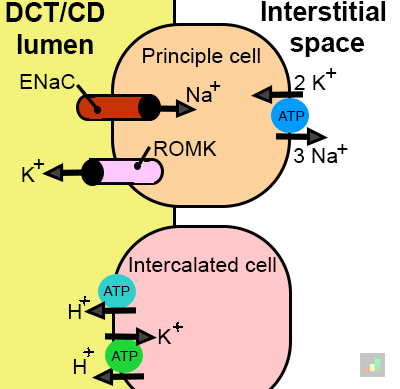 | |
Click on image to enlarge
Aldosterone acts on alpha intercalated cells of the collecting duct to increase expression of the following:
- K+/H+ ATPase on the apical membrane
- H+ ATPase on the apical membrane